
Community Stories
She’s a Beaut
A cowboy, a rollator, and learning to live the life you still want.
By Jay Armstrong · October 4, 2026 · 4 min read
“She’s a beaut.”
I turned around.
An older, barrel-chested man, probably somewhere in his sixties, was sitting in a rollator at the edge of the Grand Canyon. His faded-blue rollator had a narrow frame and four skinny little wheels that screamed for mercy.
He wore a flannel coat and a cowboy hat. He had rough hands and sunburned, leathery skin. He looked like what I imagine old cowboys look like.
Thick. Bronze. American.
He looked like he should have been riding a horse somewhere in the wilds of Texas. Not squeezed into a rollator a few feet from a Made-in-China gift shop.
There was still something about him, though. Maybe it was the cowboy hat. Maybe it was the way he carried himself. Maybe it was the swagger of a cowboy who had spent a lifetime believing the world would make room for him.
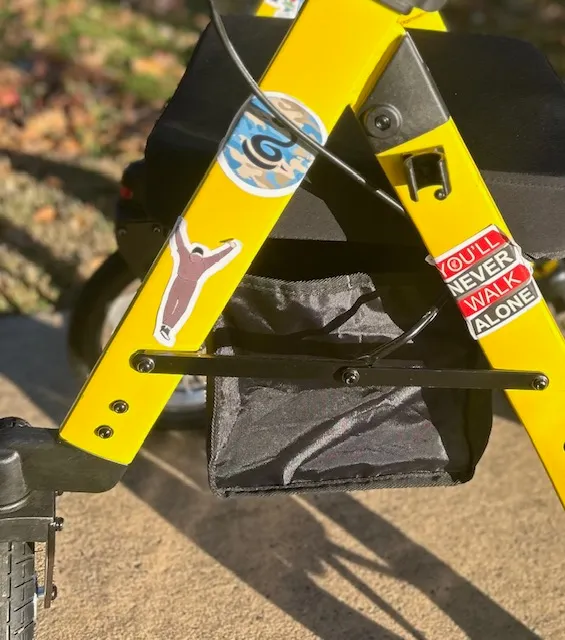
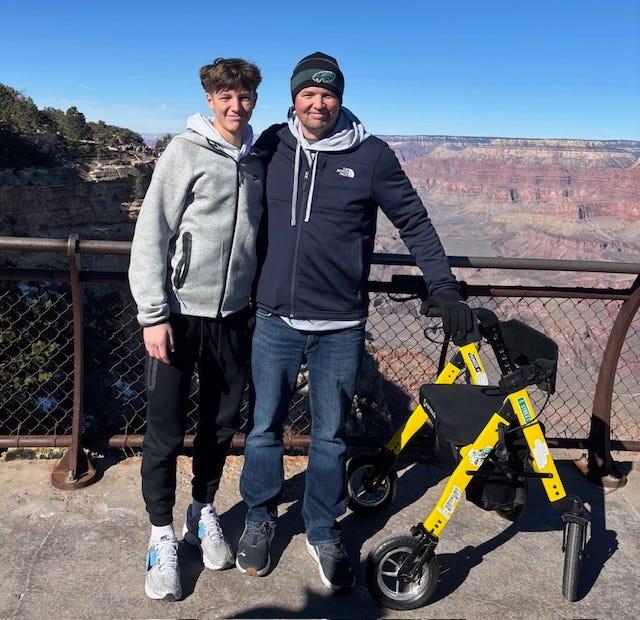
Mellow Yellow is hard to miss. She is bright yellow, has a thick frame, chrome spokes, and is covered in stickers that tell the world where I’m from. Phillies. Eagles. A silhouette of Rocky Balboa holding his arms up in victory. Basically, if you see my thirty-six-pound rollator, you know I am passionate about cheesesteaks and occasionally make questionable decisions involving Philadelphia sports teams.
“Y’all from Philadelphia?”
“Yeah. How’d you know?”
He pointed at the stickers.
He stiffened up. “I’m from Texas.” He announced it like Texas was not a state but a personality trait. Brave. Determined. Texas.
“West Texas,” he continued. “Northwestern part. East of El Paso, not too far from Mexico. Every year, we make a family trip out here. Me, my two grown sons, four grandkids.”
He paused.
“I don’t know why we keep comin’ back here, but we do. My wife says it’s some kinda spiritual retreat.”
He looked out over the canyon.
“But I ain’t never quite figured out what’s spiritual ’bout standin’ around lookin’ at a big hole in the ground.”
He shrugged.
“But she likes it.”
I laughed.
“And you keep coming back?”
He nodded.
“Yep. Reckon that’s marriage.”
He told me he had MS and needed his rollator for long walks.
Then he looked at his skinny little wheels and laughed.
“Best it’s good for is gettin’ me some root beer outta the fridge. I told my wife this thing belongs in the kitchen, not at the Grand Canyon.”
A few months later, in Philadelphia, I told my ataxia support group about the Texas cowboy I met in Arizona at the Grand Canyon.
I told them how impressed he was with Mellow Yellow. Some people in the group had their own Mellow Yellow. The Green Machine. Big Red. The Silver Surfer.
Then a timid voice asked, “Umm…aren’t you afraid of what people might think or say about you?”
The question hung in the Zoom room for a moment.
I knew exactly what the voice meant. Because I had thought about it, too. For a really long time. I was afraid of what people might think and say in private about me. About how I’m a strong, good-looking dad, not a granddad, using a rollator. How my voice sounds drunk. How my body moves like my gravity is actually settling cement.
And, for me, it was crazy demoralizing to need a device to roll through the world.
Another voice, this one declarative and slurred, said, “Fuck people. I don’t mean to be crass. I mean, not all people. Some are great. But the people that judge us because we are different aren’t worth it. They judge us because they are afraid to judge themselves.”
Someone laughed. Someone cried. Someone said, “Amen.”
Another voice, with a “been-there-done-that” cadence, said, “Safety is more important than people’s opinions.”
The timid voice returned, “Umm…yeah, but I still care what people think?”
I thought about how you eventually stop seeing the device as an object that announces your disability and start seeing it as part of how you move through the world. But I didn’t say that. I just wrote down the thought in case I wanted to angle it into some future writing piece.
The Zoom room was quiet. I stared at the faces on the computer screen. A modern, pixelated community who knew the real embarrassment and shame that becomes part of the human experience of disability.
A throat cleared.
A voice cut the silence. “The people who judge you won’t sit with you at the ER at 3 a.m.”
The cowboy and I looked at the Grand Canyon together when he asked, “Who you here with?”
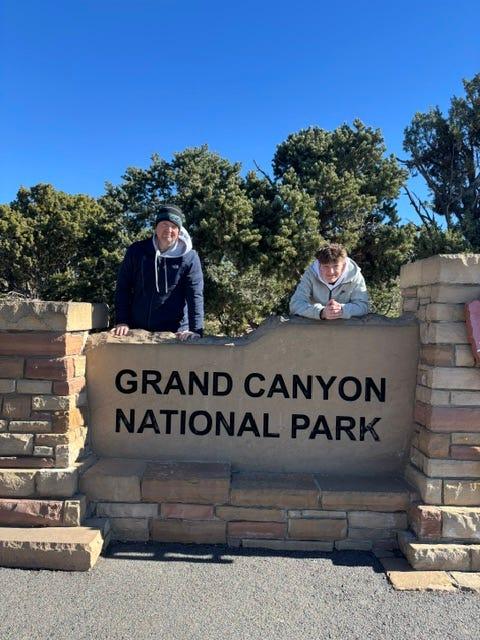
“My son and my parents.” I nodded toward them as they leaned on the black railing along the rim of the Grand Canyon.
“That’s nice.”
“Yes, it is.”
“You know, there’s an old saying in Texas that goes something like, it’s not what you’re looking at that matters. It’s who you’re looking with.”
I looked at my son and parents. They walked along the black railing, looking out over the Grand Canyon. Maybe the point isn’t to find the adaptive device that makes you look the least disabled. The point is to find the one that helps you live the life you still want to live. So you go places and see things with the people you love.
The wind ripped through my coat. The cowboy and I sat on our rollators in silence. No one was looking at us. The Grand Canyon lay before us. Human smallness all around us.
My son and parents walked toward us. They were smiling.
“I guess it’s time to go. But it was nice to meet you,” I said.
We shook hands.
“Nice meeting you, Philly.”
This story was written for The Adaptiv Edit ✍️, from Adaptiv Discovery: a place to find products designed around real life, from getting dressed and recovering from surgery to sensory needs, caregiving, work, travel, and everything in between.
About the blogger
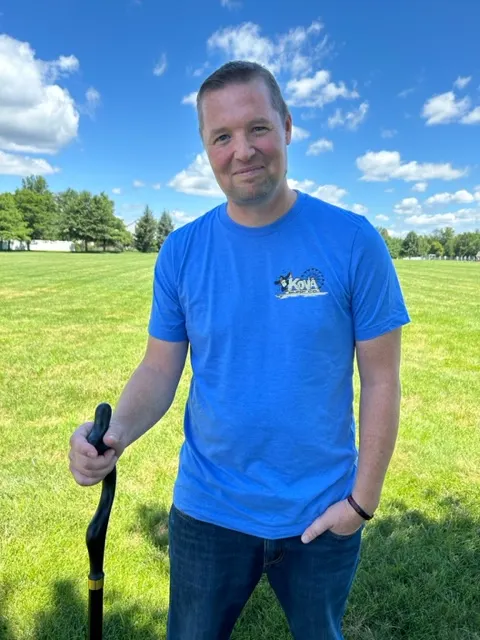
Jay Armstrong is an award-winning author of two books, Bedtime Stories for the Living and Ordinary Hero, which explore life, struggle, and resilience with humor and heart. Diagnosed with a progressive brain disease in 2013, he writes weekly letters that encourage readers to live their best lives despite their struggles. He is a dad, husband, patient advocate, and former high school English teacher who believes in the power of community and sharing our stories.
Discover what this story points to
Discover Products

More Community Stories
Fashion Has No Limits: Debunking Adaptive Fashion Myths
Fashion expert Marisa Conners separates the myths from the realities of adaptive fashion — and why style and accessibility should never be a choice.
The Side of Arthritis We Don't Talk About: What I've Learned as an Occupational Therapist
Occupational therapist Ali Merchant on how arthritis and joint mobility limits turn getting dressed into a painful task — and the adaptive design details that give back independence, privacy, and personal style.
Fashion, Function, and the Future of Adaptive Discovery
Marisa Conners on finding adaptive style that actually fits her life, and the brands she discovered on Adaptiv along the way.